
Through the fall semester of 2024, as part of my studies at Yale Divinity School, I participated in a course titled 'Art and Ritual at Mount Sinai.' Taught by two well-respected scholars of Byzantine art and architecture, Robert S. Nelson and Vasileios Marinis, the class examined the extraordinary site that is Saint Catherine's Monastery, nestled in the endless mountains of the southern Sinai Peninsula of Egypt. As part of the class, I traveled to Saint Catherine's in January 2025 to spend the better part of a week staying at the monastery guesthouse. My colleagues and I were privileged to attend worship at the monastery's basilica church, examine priceless manuscripts and icons, and experience the geography of the Sinai mountains. Our visit fell right over the celebration of the Nativity of Our Lord after the Julian calendar, and it was an exceptional experience to hike to the summit of Mount Sinai on Christmas Eve. Dramatic experiences of light, the abrasive high winds on the red-brown peaks, and a heart and mind saturated with the tangible experience of a holy place, all in the context of the imminent birth of Christ, infused that verse from the Advent 'O Antiphons' with a new kind of meaning:
O come, O come, thou Lord of Might
Who to Thy tribes, on Sinai's height,
In ancient times didst give the Law,
In cloud, and majesty, and awe.
Since at least the fourth century CE, communities of desert monks inhabited the area near Mount Sinai where the Israelites were believed to have encamped as Moses went up and down the Holy Mountain. We know about these early monks from the famous pilgrim Egeria, a devout woman from the Latin west (maybe from Gaul or Spain) who visited Sinai in the ca 380s. By the mid-sixth century, the Emperor Justinian's patronage transformed the site by erecting massive fortress walls to enclose a formal monastic complex, which included a magnificent basilica church dedicated to the monastery's original patroness, the Virgin Mary. The fortress walls of the local red-brown granite contain the nucleus of the monastic community's activities. Indeed, the Greek Orthodox monks still reside in cells within the walls, which also enclose the monastery library, where hundreds of manuscripts are held.
The basilica church, built with the altar at the true-east end at the revered site of the burning bush of Moses, likewise still shelters the daily life of prayer of the monastery. The basilica church preserves such sixth-century fittings as the wooden entrance doors and roof beams, or the stone capitals of its 12 massive pillars carved with plant and animal life. Most striking is the apse mosaic showing the Transfiguration of Christ rendered with the splendid radiance and precision of the Byzantine mosaic tradition. The Transfigured Christ shines forth from a bright blue mandorla as the corporeal figures of Peter, James, and John fall to the ground. On the walls above this scene within the apse, we find Moses twice: on the left loosening his sandals before the burning bush, and again on the right, looking down as he receives the tablets of the Law from God. It was not possible to photograph the apse mosaics myself, but I have included a photograph looking east down the basilica nave, taken at the close of vespers on Christmas Eve. If you look closely, you can glimpse the apse mosaic shimmering behind the ebullient 17th-century Cretan screen. I found it moving to only perceive the face of the Transfigured Christ through the Crucifixion. However, it is said among the monks at Sinai that no saints have emerged from the monastery since the screen was put up.
Even from this brief account of the site of Sinai – vast mountains, physical places steeped in sacred story, the sixth-century mosaics, the current rhythm of worship and prayer in communal liturgy, and so on – one becomes aware that time and space have been collapsed in an extraordinary kind of way. The Transfiguration on Mount Tabor is juxtaposed, even conflated, with Mount Sinai. The revelation of God to humanity in the burning bush and in the Law is juxtaposed with the God-bearer, the Virgin Mary, whose body brought forth the Word Incarnate revealed even now to humanity (consider the fact that the offering of the Eucharist, for instance, takes place under the apse mosaic). In all of this, the believer is invited to share in a way of seeing that is not necessarily the normal human way of seeing. Instead, the believer is invited to approach the mysteries of a God whose purposes in particular times and places have nonetheless come to transcend times and places. As one moves back and forth between the past and present through the physical site of Sinai – guided by particular imagery with theological implications, and the experience of prayer and worship – one becomes conscious, perhaps, of the ineffable mysteries of the great 'I AM' that spoke to Moses from a burning bush.
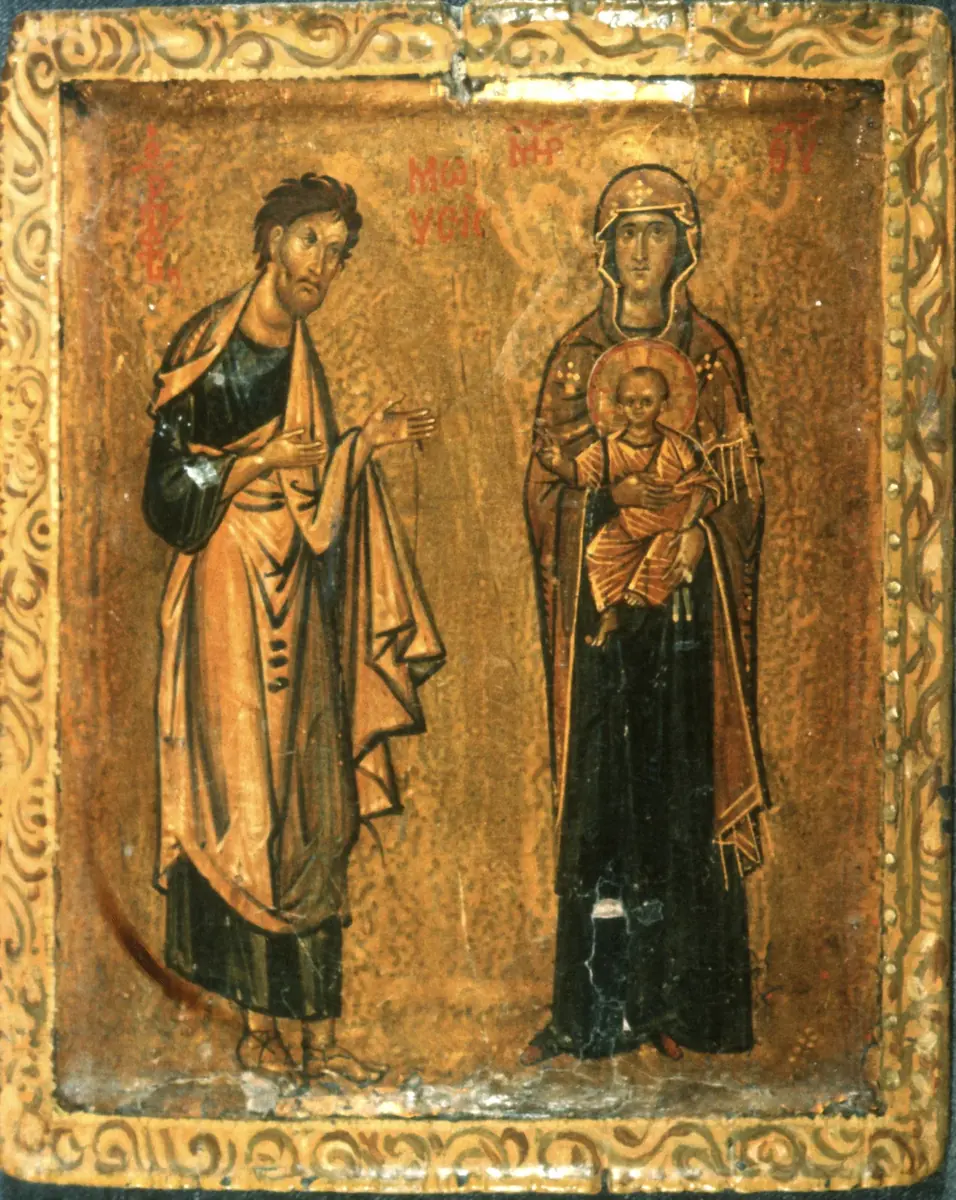
Another example of this way of seeing is demonstrated through an icon that I studied extensively during the class. It is an icon that, I believe, not only helps us get closer to this notion of 'seeing the Divine' but an icon that summarizes something of the extraordinary nature of the monastery at Mount Sinai. Produced at Sinai in the late-12th or early-13th century, and measuring only six by five inches, it shows Moses before the Virgin and Child. Moses looks directly at the Virgin and Child – 'And Moses said, I will now turn aside, and see this great sight, why the bush is not burnt' (Exod 3:3) – while the latter direct their gazes away from Moses and the viewer. I had already mentioned that the monastery at Sinai was originally dedicated to the Virgin Mary, the Theotokos, the God-bearer. The relics of Saint Catherine of Alexandria – the chief attraction of Latin pilgrims, especially during the Medieval period – do not seem to have arrived at the monastery until the early 13th century. Yet, the Virgin never lost her special status at Sinai; it seems to have taken the monks about a century to adopt a new dedication to Saint Catherine. The Blessed Virgin holds a special significance for Sinai, as Orthodox exegesis had established the burning bush of Moses as a type of the Virgin Mary. Simply put, just as the Bush was not consumed by God's presence, so was Mary's virginity not lost in the birth of Jesus (first vividly depicted in the Protoevangelium of James).
Evidence strongly suggests that the image of the Virgin and Child at Sinai was often understood to be the Virgin 'of the Burning Bush'. As in this icon, flames did not need to be shown to make the point (interestingly, many examples would show the Virgin actually engulfed in flames, often paired with Saint Catherine of Alexandria). Nor did the Virgin have to be shown with Moses – indeed, this icon is one example of about a dozen showing the Virgin and Child in the same pose with various saints and prophets. Rather, the viewer is drawn into a way of seeing that does not rely on the literal or the immediate. The fullness of God's revelation in Christ Jesus through the Virgin Mary could only be comprehended with one's understanding – through prayer, study, and contemplation – that this was also the God of Sinai's height.
This little icon would have taken on even greater significance when we understand that it was not only produced at Sinai, but probably hung in a monk's cell. A monk who would have known well the terrain of Sinai and the realities of a vocation dedicated to the hard and imperfect life of prayer in the Egyptian desert. In becoming the third party to this sacred dialogue, the monk thus brought into their own time and place the reality of the ageless God.
St John Climacus, abbot of Sinai in the 7th century, wrote in the very last chapter (or 'step') of his great treatise on prayer, The Ladder of Divine Ascent, that the one who truly loves God 'ever keeps in his imagination the face of his beloved'.1 That one might strive to behold God face-to-face was not merely an abstract notion or a pleasant idea. For Climacus it was a visceral reality, the possibility of transformation and transfiguration of the self through the long, often arduous, and imperfect life of prayer. And such prayer was something profoundly real. Prayer should, can, and does transform the way that we see, drawing us into that ineffable vision of a God who has made us, who comes to us in Christ Jesus, and who 'in ancient times didst give the Law, in cloud, and majesty, and awe'.